Knowledge, Leather Type
Full-Grain Leather Explained: What It Really Means
Okt
“Full-grain leather” is one of the most common terms used when talking about premium leather goods.
It is also one of the most misunderstood.
Many people assume full-grain automatically means the strongest, thickest, or best leather available. But full-grain actually describes something more specific: how much of the original grain surface of the hide has been retained.
Understanding that distinction is a better starting point for understanding leather quality.
What Is Full-Grain Leather?
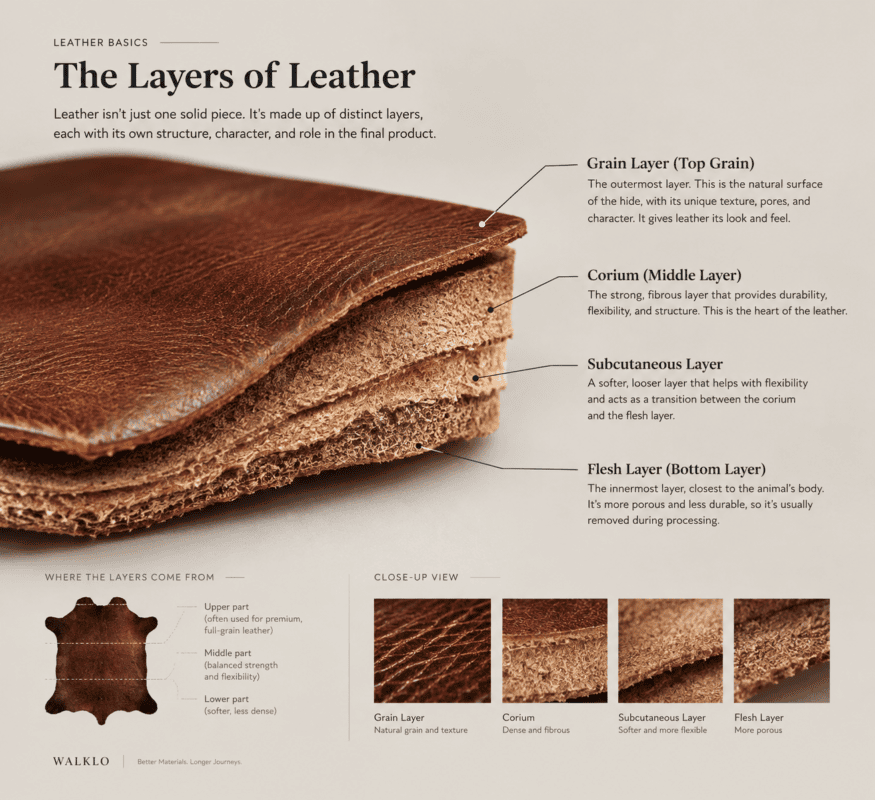
Full-grain leather retains the natural grain surface of the animal hide.
The grain is the outermost part of the hide. It contains a dense fiber structure and the natural characteristics of the animal, including pores, wrinkles, scars, and variations in grain.
When this surface is preserved, those characteristics can remain visible in the finished leather.
That is one reason full-grain leather often has a more natural appearance and can develop distinctive character through use.
But there is an important point:
Full-grain does not describe how the leather was tanned.
A full-grain leather can be vegetable tanned, chrome tanned, or produced using other tanning systems.
Full-grain and vegetable-tanned are two different descriptions of leather.
Full-Grain vs Top-Grain vs Corrected-Grain
These terms are often used together, but they describe different levels of surface treatment.
Full-Grain Leather
The natural grain surface is retained with minimal alteration.
Natural characteristics remain part of the finished leather, although the tannery may still apply finishes or treatments.
Top-Grain Leather
Top-grain generally refers to leather taken from the upper portion of the hide where the original grain is present, but the surface may have been lightly sanded, buffed, or refined.
The terminology is not perfectly standardized across the industry, so the name alone does not tell you everything about the leather.
Corrected-Grain Leather
Corrected leather has undergone more substantial surface alteration.
The surface may be sanded or buffed to reduce visible imperfections, then finished or embossed to create a more uniform appearance.
This isn’t automatically bad leather.
It simply means the surface has been intentionally modified.
The key difference is that full-grain leather preserves more of the original surface character.
Is Full-Grain Leather Always Better?
This is where leather marketing can become misleading.
Full-grain is often presented as the ultimate measure of leather quality.
But a leather product is more complicated than one label.
A full-grain leather can still be poorly tanned, unsuitable for a particular application, or badly constructed into a product.
Likewise, a leather that has undergone some surface correction can be an excellent material for a specific purpose.
Instead of asking only:
“Is it full grain?”
Consider:
- What animal hide was used?
- How was it tanned?
- How thick is it?
- How was the surface finished?
- Where on the hide did it come from?
- What will the leather be used for?
- How is the finished product constructed?
Those questions tell you much more about the actual quality and suitability of a leather.
Full-Grain and Tanning Are Different Things
Two full-grain leathers can behave very differently.
That’s because retaining the grain is only one part of the material.
Tanning transforms raw hide into stable leather, while finishing influences its appearance and surface behavior.
Vegetable tanning, chrome tanning, and other tanning systems can produce very different results even when the original grain surface is retained.
Vegetable-tanned leather, for example, is often known for developing noticeable color and patina through exposure to light, handling, oils, and everyday use.
Other tannages can produce leather that is softer, more flexible, more water-resistant, or more consistent in appearance.
So:
Full-grain describes the surface.
Tanning describes the tanning process.
They should not be treated as the same thing.
Why Does Full-Grain Leather Develop Patina?
One of the most interesting characteristics of natural leather is that it can change with use.
Handling can darken areas that are touched frequently.
Friction can polish the surface.
Light can alter the color.
Folds become more defined.
Small scratches and marks accumulate.
Over time, these changes can create patina.
But there is no single “full-grain patina.”
The result depends on the specific leather, tannage, finish, color, and how the product is used.
A heavily finished leather may change differently from a lightly finished vegetable-tanned leather.
That’s part of what makes leather interesting.
The material continues to evolve after the product is finished.
Full-Grain Leather for Bags
For leather bags, material selection has to be connected to the way the bag will actually be used.
A work bag may carry a laptop, documents, chargers, and everyday equipment.
A travel bag may experience abrasion, compression, rain, and rough handling.
A daily backpack may need more flexibility than a very thick leather can provide.
There is therefore no single leather thickness or leather type that is perfect for every bag.
The material has to work with the design.
That means considering more than the leather itself:
- panel thickness
- reinforcement
- stitching
- hardware
- lining
- stress points
- load distribution
- intended use
A beautiful leather is only part of a good bag.
Why Construction Still Matters
Imagine two bags made from the same full-grain leather.
One has weak stitching, poorly positioned stress points, and hardware that isn’t suited to the load.
The other has carefully distributed loads, appropriate reinforcement, strong stitching, and hardware selected for the application.
They use the same leather.
But they won’t necessarily have the same lifespan.
This is why we see leather quality and construction quality as connected.
For a bag intended to be used for years, the design has to account for where the leather bends, where loads are concentrated, and which components will experience the most wear.
Material selection is part of construction.
Our View on Full-Grain Leather
At Walklo, we don’t think leather quality can be reduced to a single label.
We look at the material itself—its hide, origin, tannage, surface treatment, thickness, and intended use.
We are interested in different hides because they behave differently.
Bison has its pronounced natural grain.
Shell Cordovan has a completely different structure and character.
Different vegetable-tanned leathers can also behave very differently from one another.
The interesting part is understanding those differences and using each material intentionally.
Because a good leather bag shouldn’t only look good on the day it is purchased.
It should make sense years later.
FAQ
Is full-grain leather the highest quality leather?
Full-grain is generally considered a premium leather category because it retains the natural grain surface. However, the label alone does not guarantee overall quality.
Is full-grain better than top-grain leather?
Not automatically. Full-grain retains more of the original grain surface, while top-grain may have undergone some surface refinement. The right choice depends on the intended application.
Is full-grain the same as vegetable-tanned leather?
No. Full-grain describes the condition of the grain surface, while vegetable tanning describes the tanning process.
Does full-grain leather last longer?
It can be extremely durable, but lifespan also depends on the hide, tanning, thickness, finishing, construction, and how the product is used.
Does full-grain leather develop patina?
It can. The extent and appearance of patina depend on the specific leather and finish.
The Point of Good Leather
The value of natural leather isn’t that it stays perfect.
It is that it can remain useful while changing.
A scratch doesn’t necessarily mean the end of a bag. A darker handle doesn’t mean the material has failed.
Those marks can become part of the object’s history.
Don’t keep it new. Keep it going.
Leather goods made for work, travel, and the years ahead.
Designed to take marks.
Built to develop character.
Made to go the distance.


