Knowledge, Leather Type, Uncategorized
Full-Grain Leather Doesn’t Always Mean Better Leather
Sep
“Full-grain leather” is one of the most common phrases you will see when shopping for a leather bag.
It is also one of the most misunderstood.
Full-grain leather can be excellent. But the words alone do not tell you everything about the quality of a finished leather product.
After years of working with leather, we think there is a better way to look at it.
What Does Full-Grain Actually Mean?
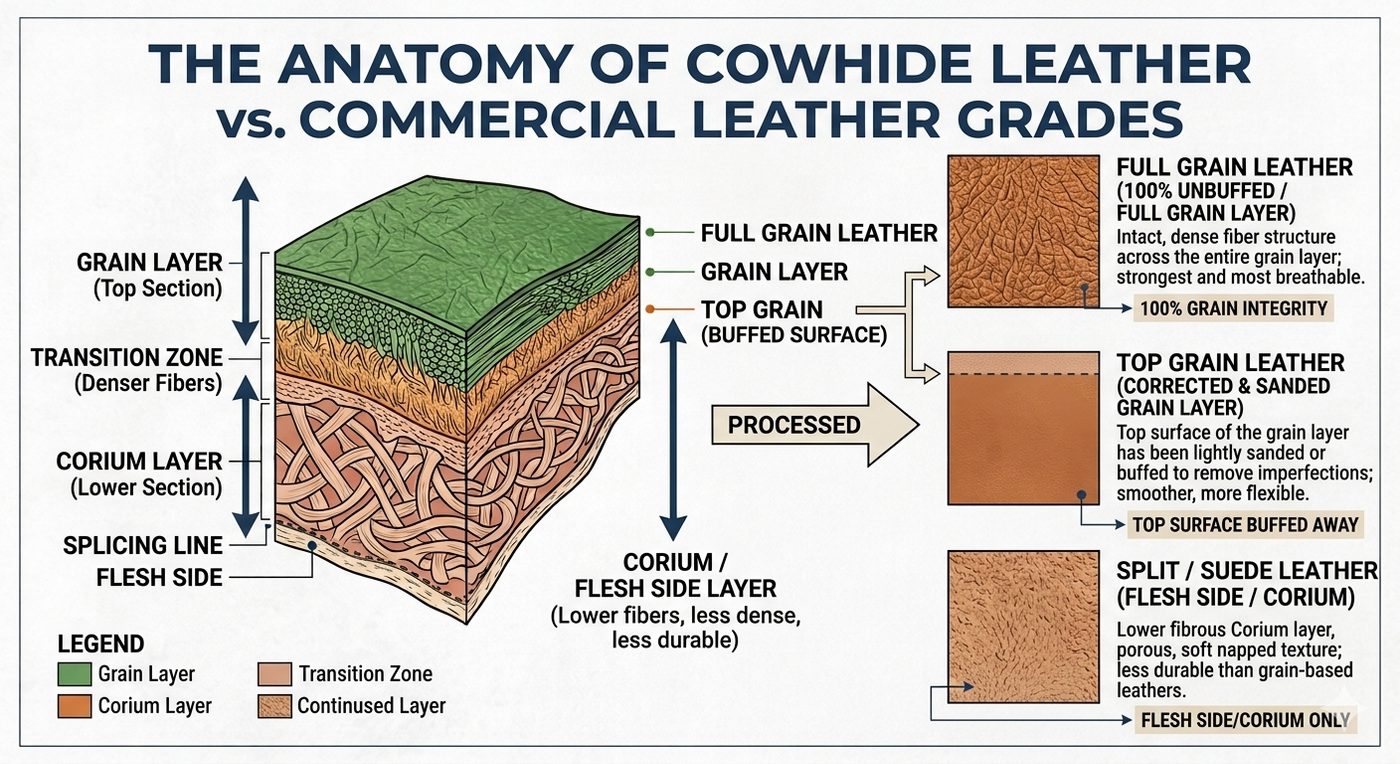
Full-grain generally means that the natural grain surface of the hide has been retained rather than heavily sanded or corrected.
That matters because the grain is part of what gives leather its natural structure and appearance.
You may see pores, scars, wrinkles, insect marks, or variations in texture.
These are not necessarily defects.
They can simply be evidence that the leather has not been made to look perfectly uniform.
But Full-Grain Is Only One Part of the Story
Two pieces of full-grain leather can behave very differently.
Why?
Because leather quality also depends on factors such as:
- the quality and selection of the hide
- where the hide comes from
- the tanning process
- the thickness
- the finishing
- the density and structure of the leather
- how the leather is cut and constructed
A beautifully finished full-grain leather can be excellent for one application but unsuitable for another.
A very firm leather may be ideal for a structured briefcase, for example, while a softer leather may work better for a relaxed travel bag.
The right leather depends on what you are making.
Natural Marks Are Not Automatically a Problem
One reason we like natural leather is that it does not always look identical from one piece to another.
A small scar, wrinkle, or variation in grain can tell you something about the original hide.
Of course, not every mark is desirable. Excessive damage, weak areas, poor finishing, or inconsistent tanning can affect performance.
The point is that uniform appearance and leather quality are not the same thing.
Look Beyond the Label
When choosing a leather bag, don’t stop at the words “full-grain.”
Ask what kind of leather it actually is.
How was it tanned?
How thick is it?
How is it finished?
How does it feel?
How is it expected to age?
And perhaps most importantly:
Is the leather appropriate for the way the product will actually be used?
That is how we approach leather at Walklo.
We explore different hides, tanneries, finishes, and weights because there is no single leather that is perfect for everything.
Cowhide, bison, horsehide, and Shell Cordovan each have their own character.
The interesting part is understanding why.
Explore Walklo leather goods → [LINK TO COLLECTION]
Don’t keep it new. Keep it going.


